
Red Flags in a Car and Air-Care Fragrance Supplier, and What They Mean
Most red flags in air-care sourcing are not lies, they are gaps, and the distinction matters because a gap can be closed with a question while a lie should end the conversation. A supplier that cannot name its housing supplier is a different problem from one that will not say who owns the mould. The warning signs worth acting on are the ones that concern control: over components, over versions, over testing and over the paperwork that follows the goods. Read them early, while changing supplier still costs a fortnight rather than a season.
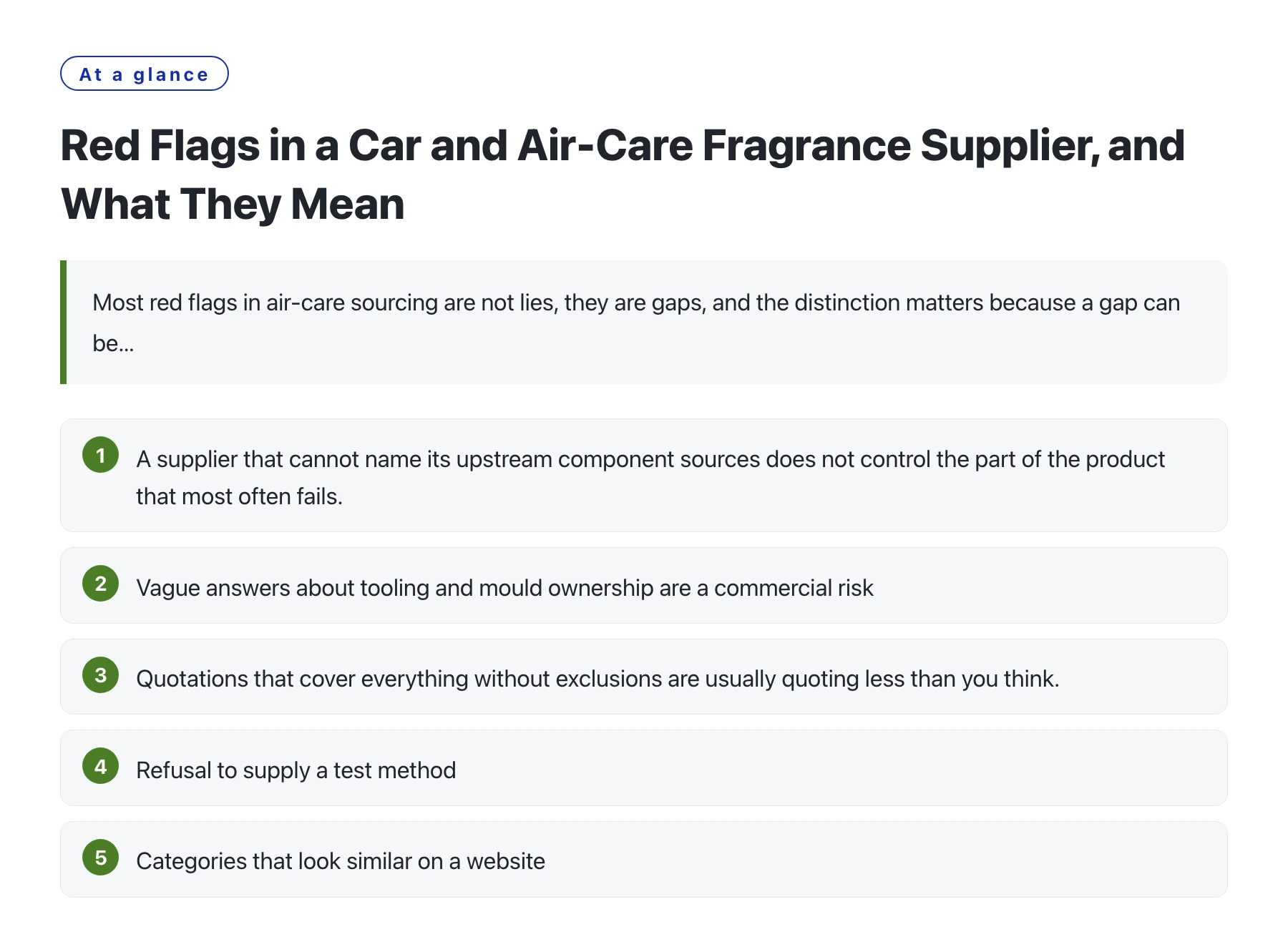
Key takeaways
- A supplier that cannot name its upstream component sources does not control the part of the product that most often fails.
- Vague answers about tooling and mould ownership are a commercial risk, not a technical one, and they surface when you try to leave.
- Quotations that cover everything without exclusions are usually quoting less than you think.
- Refusal to supply a test method, as opposed to a test result, is the single most useful warning sign in this category.
- Categories that look similar on a website, such as perfume and air care, are different production problems, so ask for evidence rather than adjacency.
Founders doing a first air-care order tend to look for disqualifying facts: a missing certificate, an implausible claim, a factory that does not exist. Those cases are rare and easy. The commoner situation is a supplier that is real, willing and underprepared for the specific format, and the signals are quieter: a hesitation about component sourcing, a quotation with no exclusions, a test report with the conditions page missing.
This article is written for a founder or buyer who is about to commit to a first car or home fragrance order and wants to know which hesitations deserve a follow-up question and which deserve a walk away.
Why air care attracts a particular kind of supplier
Home and vehicle fragrance has become a steady category for many brands, and steady categories attract suppliers that can compound scent and would like to sell into it. Compounding ability is real and transferable, but the delivery system is not free. A factory that produces excellent fine fragrance may have no experience of a wick that clogs, a film that creeps, or a housing that crazes after a summer on a dashboard.
That is not dishonesty. It is a scope boundary that has not been stated, and it becomes a problem only when nobody says it out loud. The first useful question is therefore not whether the supplier makes air care, but which parts of the delivery system it manufactures, which it buys, and which it has never tested.
Warning signs and what each one usually indicates
| What you notice | What it usually means | The question to ask instead |
|---|---|---|
| Component suppliers cannot be named | The factory buys through a trader and has limited control over substitution and lead time. | Ask for the drawing number and the last three incoming inspection records for the housing or wick. |
| No exclusion list in the quotation | The price covers the scent and filling only, while tooling, decoration and testing will be added later. | Ask for a written list of what is not included, with an indicative cost for each excluded item. |
| Test results without conditions | The test was run to an internal habit rather than to a defined protocol, and the result may not transfer to your format. | Ask for the method, the number of samples, the duration and the temperature range. |
| Tooling and mould ownership left vague | The tool is held by a third party, which limits your ability to move the product later. | Ask who holds the tool, who can collect it, and what the transfer would cost. |
| Enthusiasm with no questions about your market | Restrictions and labelling obligations for the destination markets have not been considered. | Ask which product category it is applying and which markets that classification covers. |
| A long list of adjacent categories, no specific air-care references | Capability is being inferred from adjacency rather than demonstrated on a similar product. | Ask for the most recent format that failed in testing and what changed afterwards. |
| Pressure to skip the sample stage | A short deadline is being managed by removing a gate rather than by resourcing the work. | Ask what the sample stage is meant to catch, then ask what replaces it. |
None of these signs is fatal on its own, and a supplier can be weak in one area and strong overall. What should change your behaviour is repetition: three vague answers in a first meeting describe a working style rather than an unlucky conversation.
Two checks that are worth doing properly
Ownership of what you paid for
In air care the formula is only part of what you are buying. The mould, the decoration artwork, the housing specification and any custom mechanism all carry rights, and the question of who owns each of them is a legal question rather than a technical one. Intellectual property frameworks differ between jurisdictions and the practical protection comes from what is written in the agreement, so the useful move is to agree ownership in the contract rather than to assume it follows the invoice [1].
A short written schedule naming each asset, its owner and the conditions of transfer costs almost nothing at signing and saves an argument later. If a supplier resists putting it in writing, treat that as the finding rather than as a negotiating position.
Scale of the operation behind the claim
The category has grown steadily enough that new suppliers continue to enter it, which means a supplier's website may be newer than its production experience [2]. Age is not quality, but a very young company presenting a long history should be asked for the part of the record that is checkable: production dates, batch sizes, markets served and the names of the entities involved.
A verifiable company description is worth more than an impressive one. Where a manufacturer publishes its own history and certifications, the useful test is whether the claims are specific and consistent across pages; Xuelei's 31 years in fragrance is an example of a company stating an age and a set of standards in its own words, and the same claims should be checked against the documents when you ask for them.
The broader diligence sequence matters more than any single answer, and a 31-year-old fragrance manufacturer in China covers the order in which the checks should be run. For air care, add one item to that sequence: a component inspection record, because it is the document that most reliably separates a manufacturer from a seller.
If the answers hold up, the last red flag test is the simplest. Ask the supplier who the counterparty will be on the contract, confirm that it is the entity that will actually produce the goods, and check that it is old enough and large enough to be the party named. A manufacturer with a stated operating history, such as Xuelei, is at least a party you can identify, question and hold to a written schedule.
Keep a one-page risk note for each supplier you speak to, with the date and the unanswered questions on it. Diligence fails less often from a lack of information than from a good impression that nobody wrote down.
Sources
- WIPO — World Intellectual Property Organization —— The UN agency for intellectual property; resources on industrial design and patent protection relevant to product and packaging design.
- Mintel Press Centre —— Mintel's press releases on consumer and beauty market research, including fragrance and personal care trend reporting.
Frequently asked questions
Is a supplier that does not make its own housings automatically a bad choice?
No. Many manufacturers buy components, and that can be an advantage. The concern is whether they control the specification and inspect what arrives, which you can check by asking for drawings and incoming records.
What should we do if a quotation arrives with no exclusions?
Ask for a written list of what is not included, with an indicative price for each item. Then compare it with the other quotations on the same basis rather than on the headline number.
How much does air-care experience matter?
It matters most for the delivery system rather than the scent. Ask specifically about a format that failed testing and what changed, because that answer cannot easily be constructed without experience.
Should we walk away from a supplier that will not name its component sources?
Give it one chance to answer in writing. If it cannot name the sources or provide inspection records, you have no way to manage substitution, and that is a real risk rather than a formality.
How early should we raise ownership of moulds and artwork?
Before signing, in a written schedule. It costs nothing while everyone is enthusiastic and becomes expensive once money has changed hands.