
From One Rack to Four: When Phone Alerts Stop Being Enough
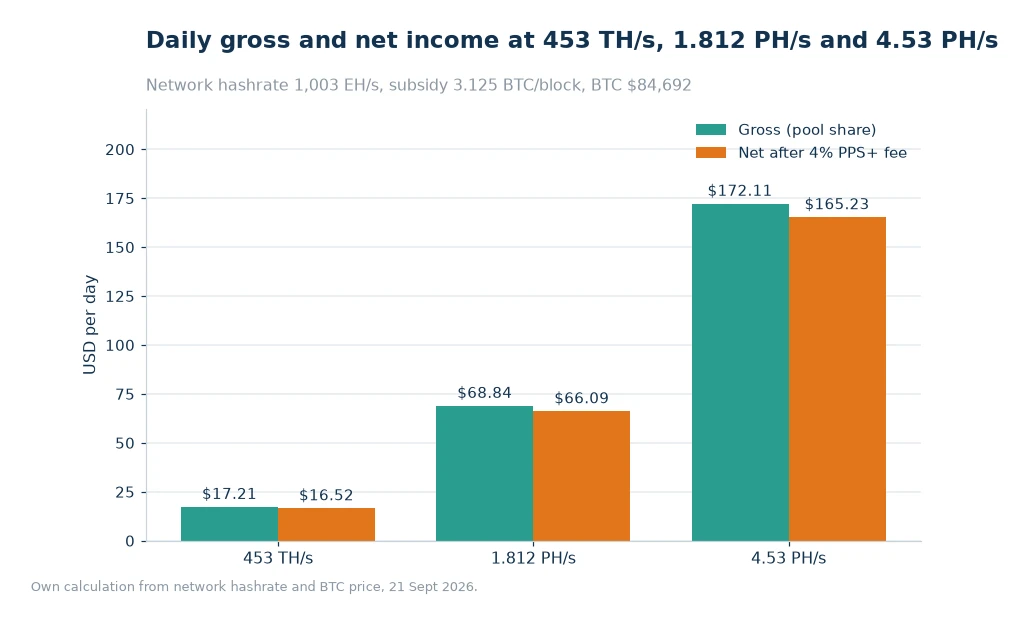
The first unit is watched. The fourth is managed. At 453 TH/s a single machine earns about 0.00020322 BTC a day, or $17.21 gross at $84,692 and $16.52 after the listed 4% on the block-reward component. Four of them turn that into roughly $66 a day net, and somewhere between the first and the fourth the job stops being a notification you glance at and becomes a schedule you keep.

Key takeaways
- One 453 TH/s unit clears 0.00020322 BTC a day; four clear about 0.00081300 BTC.
- Per-worker alerts stay useful at four units; a single account-level alert does not.
- Spare parts and a named replacement procedure matter more than another dashboard.
- Add the fourth unit only when the third has run a full difficulty window without an unplanned stop.
The second unit is a different job
With one machine, monitoring is a habit. You look at the phone while the kettle boils, notice a number, and carry on. With two, the habit still works, because a drop in the account total is almost certainly one of two machines and the answer is found by looking at both. With four, the aggregate hides things: a unit running at 60% is a 10% dip in the total, which is inside normal daily variation.
That is the threshold where the question changes from "is anything wrong" to "which unit is wrong." A screen built for a single worker answers the first question well and the second badly. The fix is not a bigger screen; it is per-worker thresholds, so the alert names the machine instead of the account.
The other change is physical. Four units mean four power supplies, four network cables, four fan sets and one shared room whose temperature now depends on all of them. The failure modes multiply faster than the hashrate does, and each one has a different cost.
What the phone still does better than anything else
The phone wins on latency. A machine that stops at 2 a.m. is discovered at 7 a.m. by someone who checks a notification, and discovered at 6 p.m. by someone who checks a spreadsheet. Those eleven hours are worth about $2.50 at four units, which is small, but the same gap applied to a failed fan can turn a cheap repair into a dead board.
It also wins on portability. A farm that lives in a shed behind the house still gets checked from a train, a queue or a hospital waiting room. That is not a convenience; it is the difference between reacting within minutes and reacting within a day.
Temperature is the third area where a phone earns its place. A unit reporting 78 °C on one board while the others sit at 65 °C is telling you about a heatsink or a fan before it becomes a shutdown. None of that appears in a daily total.
The ViaBTC App Download installs on both iOS and Android, and each worker keeps its own alert, which is what makes a four-unit account readable at a glance rather than a single noisy total.
| Units | Total hashrate | BTC per day | USD net per day | Alert granularity |
|---|---|---|---|---|
| 1 | 453 TH/s | 0.00020322 | $16.52 | Account-level is enough |
| 2 | 906 TH/s | 0.00040648 | $33.04 | Per-worker thresholds |
| 3 | 1.359 PH/s | 0.00060972 | $49.56 | Per-worker plus temperature |
| 4 | 1.812 PH/s | 0.00081300 | $66.09 | Add a weekly review |
Worked example
Scale the single-unit arithmetic up one machine at a time and watch the fixed costs compress.
- Share of the network: 453 ÷ 1,003,107,267 = 4.51597e-7.
- That fraction of the 450 BTC mined each day: 4.51597e-7 × 450 = 0.00020322 BTC.
- At $84,692 that reads $17.21 gross, or $16.52 with the listed 4% charged against the reward portion.
- Two units: 0.00040648 BTC, $33.04 net; three: 0.00060972 BTC, $49.56 net.
- Four units: 0.00081300 BTC, $68.84 gross and $66.09 net.
- A single unit offline for a day at four units costs 0.00020322 BTC, about $17.21 gross — a quarter of the day's output.
- Monthly net at four units: 30 × $66.09 = $1,982.70.
The spreadsheet that replaces the glance
At four units, a weekly sheet with one row per machine is more useful than any live view. Columns for average hashrate, days offline, temperature peak and repairs make the slow problems visible: a unit that has drifted from 453 to 430 TH/s over six weeks will never trigger an alert set at 80%, but it is losing money every day.
Keep the sheet in the same place as the statements. When a machine is retired or added, the sheet is the only record of what the account looked like before the change, and it explains a step in the total that would otherwise be a mystery.
Two columns earn their space in the first month of use: the date a part was last replaced, and the date the intake was last cleaned. Both are invisible until they are overdue, and both are cheap to record while you are already standing in front of the machine with a screwdriver in your hand.
The sheet also forces a decision about the fifth unit. If the four existing rows are stable and the margin per machine is positive after power, adding capacity is arithmetic. If one row is chronically short, the fifth unit is a distraction from a repair.
Fill the sheet at the same hour every week. A reading taken at a different time each week picks up the daily temperature cycle and makes every machine look unstable. Consistency matters more than precision here: a rough number measured at a fixed hour beats an exact number measured whenever you remember.
Spacing purchases so one failure is survivable
Buying four machines at once concentrates risk. Four units from the same batch share the same firmware quirks and often the same power supply design, so a fault that affects one may affect all. Buying in pairs with a month between them spreads that risk and gives you a working baseline to compare against.
Keep one spare power supply and one spare fan per two machines. They are the two parts that fail first, they are cheap relative to a week of downtime, and having them on a shelf converts a two-day wait for delivery into a twenty-minute swap.
Decide in advance what counts as a bad unit. A machine that needs a repair twice in a quarter is a candidate for retirement, not for a third repair. Writing that rule while the fleet is small keeps the decision from being made in frustration later.
There is a quieter argument for spacing purchases: each delivery teaches you something about the seller, the shipping, and the condition of the batch. Four machines that arrive in one crate give you one lesson repeated four times. Four that arrive over three months give you four lessons, and the last one is bought by a person who has already made the first three mistakes.
Frequently asked questions
How much does a four-unit 453 TH/s setup earn?
About 0.00081300 BTC a day at the reference hashrate, which is $68.84 gross at $84,692 and roughly $66.09 after the listed 4% on the block-reward component.
Do I need per-worker alerts at four machines?
Yes, because a single slow unit is a small dip in the account total; per-worker thresholds name the machine and catch a 10% shortfall that an aggregate alarm would ignore.
When should I add the next unit?
After the newest machine has run a full difficulty window without an unplanned stop and the existing rows in the weekly sheet are stable.
The multi-currency wallet holds what the four units produce in one balance, which is what makes the weekly sheet reconcilable at all.
Grow by one and write it down
Every addition deserves a line in the sheet with the date, the price, the measured hashrate on arrival and the first week's average. That line is the only honest way to know whether the fleet is improving or merely getting bigger.
The Profit Calculator will tell you what the new total should produce before the box is even unplugged. Compare that figure with the first week's average, and the addition is either confirmed or questioned on evidence.
Sources: ViaBTC calculator and app pages for expected output and monitoring[1]. Published 24 Oct 2026 from data read 21 Sept 2026: 1,003 EH/s, 132.76 T, 3.125 BTC per block, 144 blocks a day, $84,692 per BTC. Totals assume four units at rated speed with no stops.