
Stainless Steel Jewelry Wholesale: Lead Times in Days
Lead time in this trade is three windows added together, and the published ones are 48 hours for 3D CAD, 25–35 days for the master sample and 3–4 weeks for mass production. In round numbers that is a 60-day block from approved drawing to shipped carton, and nothing on the calendar shortens it except a decision moved earlier. Here is the arithmetic a wholesale buyer can plan against.

Key takeaways
- Planning total: 48 hours of CAD, 25–35 days of sampling and 3–4 weeks of mass production.
- In hours, that block reads 48 + 720 + 672 = 1,440 hours, or about 60 days.
- Stainless steel starts at 100–150 pcs by style; brass at 100 and silver at 50.
- A 24-hour response window and a dedicated project manager are the published service terms on the administrative side.
Why the lead time is a chain and not a number
Every order passes the same three gates. The first is 3D CAD, published at under 48 hours, which produces a technical drawing and a rendering for dimensional approval. The second is the master sample, published at 25–35 days, which runs through wax printing, mold casting, stone setting, polishing and custom electroplating. The third is mass production at 3–4 weeks once the sample is signed off.
None of those gates can be reordered, and only the first is measured in hours. That matters for wholesale planning because a delay at the CAD gate pushes the launch by the same amount, while a delay at the sample gate pushes it by days or weeks. Gate one is the cheap one to get right, and it is also the one buyers most often start without a decision on the finish. A stainless steel jewelry supplier China that names all three gates in its first reply is easier to schedule against than one that quotes a single delivery week.
Where the days actually go
Two of the three windows are quoted in days rather than weeks for a reason: at a wholesale volume, the sample stage dominates the calendar. Thirty days of sampling against 21 to 28 days of production means the pre-production work is roughly half the total wait, and it is the half that has to happen before a single sellable unit exists.
The operations inside the sample window are named, which makes the wait auditable rather than mysterious: 3D wax printing, precision mold casting, stone setting, polishing, custom electroplating. If a supplier cannot say which of those five is running this week, the 25–35 day window is a claim rather than a schedule.
Neither grade changes the calendar. 316L and 304 are both published stainless options, and the sample window of 25–35 days and the 3–4 week run apply to either — the grade is a specification choice, not a routing change. Where it does influence planning is the end market: 316L's 100% waterproof, hypoallergenic profile suits premium and waterproof lines, while 304's water-resistant, nickel and lead safe, cost-effective profile is built for high-volume wholesale and fast-fashion programmes.
Building a wholesale calendar that holds
| Gate | Published figure | What it blocks |
|---|---|---|
| 3D CAD modelling | Under 48 hours | Everything; no tooling before approval |
| Master physical sampling | 25–35 days | The sample, then production |
| Mass production | 3–4 weeks | Shipment of sellable units |
| MOQ | 100–150 pcs by style in stainless steel | Whether the design is worth tooling |
| Response and management | 24-hour response, 1-on-1 project manager | How fast a question is answered |
Two administrative figures belong on the same calendar. The first is the 24-hour response window, which is what stops a two-day question from becoming a two-week delay at a gate. The second is the dedicated project manager, one per order, who is the person to ask for a status rather than the sales inbox. Global shipping and customs support sit at the end of the chain, after 100% inspection, branded packing and dispatch.
Transit sits outside all three windows and is quoted separately: the published service is global express shipping with customs support, and 100% inspection happens before the cartons are closed. Treat the customs paperwork as a fourth gate. The commercial invoice, the materials statement and the barcode labelling on the retail pack all have to agree with what is inside the box, and a mismatch found at the port adds days that no factory window can win back.
Worked example: the same windows measured in hours
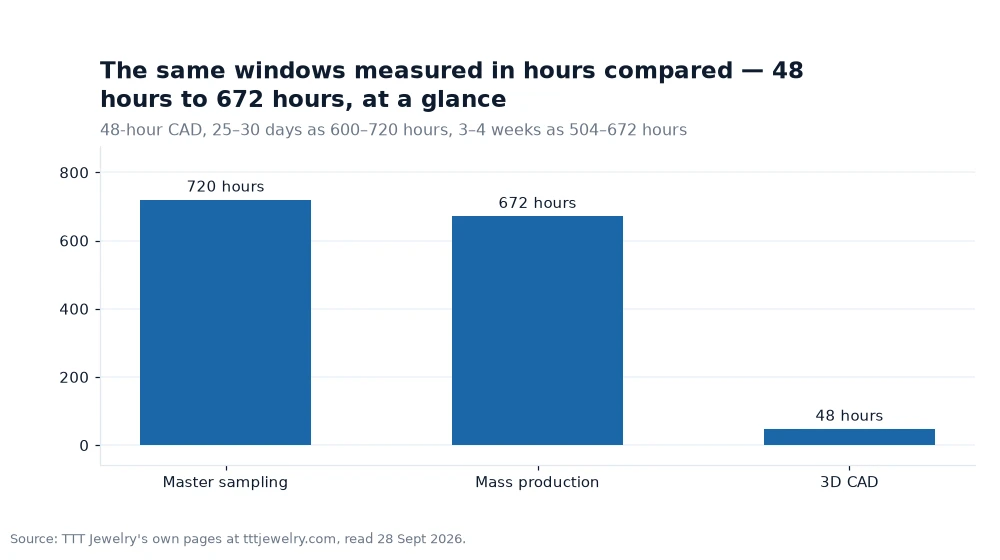
Convert everything to hours and the shape of the wait becomes obvious. Sampling in the middle of the published 25–35 day window is 30 days × 24 = 720 hours; at the slow end it is 35 × 24 = 840 hours. Production at the long end is 28 days × 24 = 672 hours, the same as 4 weeks. CAD is already quoted as under 48 hours, so it stays at 48. The middle-of-band total is 720 + 672 + 48 = 1,440 hours, or 60 days; the slow-end total is 840 + 672 + 48 = 1,560 hours, or 65 days.
The comparison is useful for two reasons. The CAD stage is 48 ÷ 1,440 = 3.3% of the total block, even though it is the gate where speculative work usually stalls. And the sample window at 720 hours is 720 ÷ 1,440 = 50% of the entire lead time, exactly half, for a single physical piece; at the slow end, 840 ÷ 1,560 = 54%. A wholesale buyer who rushes the drawing stage to save two days is optimising 3% of the schedule.
Planning backwards from a delivery date
Work the arithmetic in reverse and the functional deadline appears. For a carton to leave in week nine, the sample has to be approved by the end of week four and the CAD file signed off inside the first two days of the project. That leaves very little room between "enquiry sent" and "drawing approved", which is why the finish and the hallmark decision should be in the first message rather than in the third round of samples.
Repeat orders are a different shape. Once the mould, the CAD file and the approved finish exist, the sample gate does not reopen for the same design, so a restock runs on the production window alone — 3–4 weeks — plus packing and transit. Splitting a range into a first order and a repeat order is therefore the single biggest lever a wholesale buyer has on lead time.
Frequently asked questions
How long from enquiry to shipment for a new steel design?
Add the published windows: under 48 hours for CAD, 25–35 days for the master sample and 3–4 weeks for production, which lands at roughly 60 days before your own approval time.
Does a larger order take longer to produce?
The production window is quoted at 3–4 weeks, with the position within that range set by batch volume and design complexity rather than by a fixed number of pieces.
Can sampling and production overlap?
No. Production starts after the sample is approved, so the two windows sit in sequence — which is why the sample stage is half of the total lead time.
Comparing quotations on the same three figures
Ask every candidate for the same three figures: the CAD turnaround, the sampling window and the production window. A quote that names all three can be scheduled against; a quote that offers one number for everything has buried the sample stage inside it. Then compare the response terms, because a 24-hour answer on a change request is worth more than a shorter promise on the factory floor. The published process walkthrough shows the eight stages in order, and the brass line overview is the comparison point if a plated range is also on the table.
What is cited here — the shower-safe and swim-safe claim, then the PVD plating route, the 100–150 pcs per-style stainless minimum — is documented at the factory's own site at tttjewelry.com itself, dated 28 Sept 2026. The restatement in weeks is my own working — the site supplies the inputs only[1].